

How Two Young Nigerians Are Rewriting the Future of Education**
In a country where discouragement has become a national language, and where the system often seems designed to suffocate creativity rather than nourish it, two young Nigerians have quietly built a solution that confronts one of the nation’s most persistent crises: secondary school education.
In the aftermath of WAEC’s controversial 2025 results — a moment that exposed deep fractures in Nigeria’s learning structure — Divine Iloh and Ebuka Osunwoke stepped forward with SabiScholar, an offline-first, AI-powered learning ecosystem designed specifically for African realities. Their work is not a response to motivation. In truth, motivation is scarce in Nigeria. What drives these young men is something deeper, something internal, something that defies the limitations around them: intellectual stubbornness and the courage to think where others have accepted defeat.
Divine, a senior data analyst at Walmart and holder of a Nigerian technology patent, did not wait for ideal conditions. He studied the frustrations of thousands of students who could not access online learning because of network failures. He observed that even Nigeria’s so-called “online university” required physical presence to study. It made no sense — and in that confusion, he found a question worth solving.
Ebuka, equally relentless, brought the clarity of a mind trained to build — not complain. Together, they created an AI system capable of predicting when a user’s device would have the strongest network connection, downloading all learning resources in the background so Nigerian students can learn freely, without relying on unstable connectivity.
In a country where even the most brilliant ideas often die in silence, this was a breakthrough born not from privilege, but from persistence.
Their pilot program, involving over 2,900 students, proved that excellence multiplies when access is fair. Students using SabiScholar performed significantly better than the national average — not because of magic, but because the learning experience was finally designed for them, not imported from elsewhere.
Yet what sets Divine and Ebuka apart is not merely innovation. It is their worldview. It is their refusal to accept limitation as destiny. It is their belief — rare among their age group — that Nigeria’s problems are invitations, not verdicts.
Their journey raises a profound question for the Nigerian youth:
What are you angry enough to fix?
Because every major innovation begins with dissatisfaction. Divine and Ebuka simply grew dissatisfied with the fact that millions of students lacked access to quality learning. They chose not to complain; they chose to create.
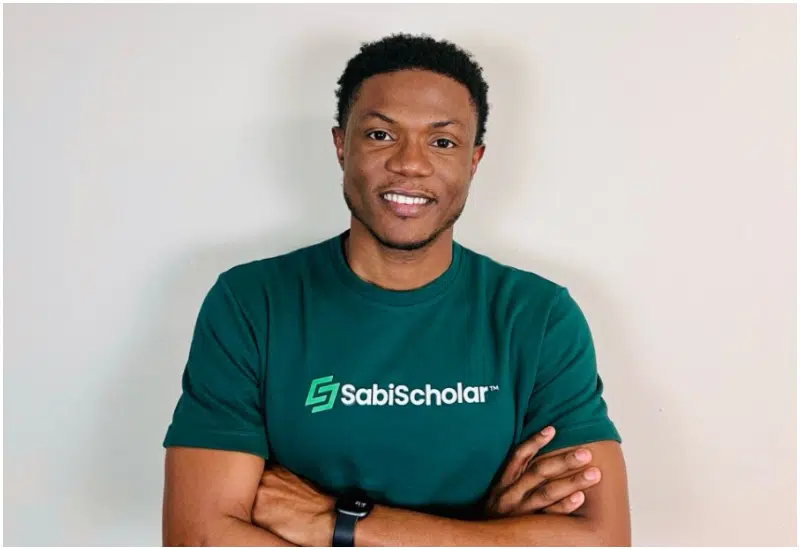 As SabiScholar continues to expand — with new systems for teachers, curriculum generation, automated assessments, and career-path predictions — the platform is steadily evolving into a full educational infrastructure that could transform how African students learn.
Where will these young innovators be in ten years? If they maintain this discipline, this intellectual courage, this refusal to fold under national despair, they will not simply run a company — they will lead an educational movement. Their work has the potential to influence learning policy, democratize tertiary access, and reshape the role of technology in African education.
But beyond their achievements lies the true value of their story:
They prove that genius is not scarce in Nigeria — opportunity is.
And while the system delays, the youth must not.
This edition names Divine Iloh and Ebuka Osunwoke as our models not because they are exceptional in skill, but because they are exceptional in courage. They represent what happens when a young person dares to think beyond the walls of a broken environment.
To every young reader:
These boys are not ahead of you because they are lucky.
They are ahead because they acted.
And action — even small, even uncertain — is the only thing that separates dreamers from builders.
If Divine and Ebuka can challenge Nigeria’s biggest educational problems at their age, then so can you challenge the small problems in your community, your school, your city, your field.
Your idea may not change the whole country.
But it may change enough to matter.
And that is how revolutions begin.
For a better experience in commenting on BoldWalk, please ensure you are logged in on our site before commenting or simply use any of your existing online accounts like google to sign-in. See the dropdown select Login option below.